
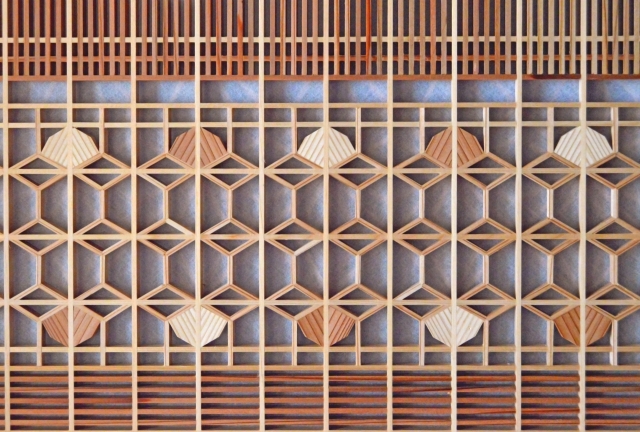
Kumiko is a traditional Japanese woodworking technique that creates geometric patterns by precisely assembling wood without using any nails. Its history dates back to the Asuka period, having been passed down for over 1,400 years. Kumiko, which requires delicate techniques with millimeter-level precision, features hundreds of beautiful patterns, and fuses the warmth of wood with elegance, can be called the pinnacle of Japanese woodcraft. This technique, which has been used in shoji screens, transom panels (ranma), and joinery, is now attracting attention as interior decoration and art pieces in modern times.
What is Kumiko?
Kumiko is a traditional craft that cuts thin wood into fine pieces and creates patterns by assembling wood to wood without using nails or adhesives. The name “kumiko” comes from “assembling” (kumu) wood. Each component is processed with millimeter-level precision, allowing no margin for error.
The greatest feature of Kumiko is not using nails or adhesives. It is assembled using only friction and pressure between wood pieces, and properly made Kumiko maintains its shape for hundreds of years. This technique developed in adaptation to Japan’s hot and humid climate. While wood expands and contracts with humidity, Kumiko’s structure absorbs this movement and prevents distortion.
History of Kumiko
The origins of Kumiko date back to the Asuka period (late 6th to early 8th century). Techniques introduced from China along with Buddhist architecture underwent unique development in Japan. Kumiko techniques were already used in the architecture of Horyuji Temple, known as Japan’s oldest Kumiko work.
From the Heian to Kamakura periods, Kumiko came to be widely used in transom panels and lattices of temple architecture. During the Muromachi period, Kumiko became an important decorative element in tea room and shoin-style architecture. Kumiko techniques were also applied to shoji screen frames, favoring simple yet beautiful linear patterns.
In the Edo period, Kumiko became further refined, with complex and elaborate patterns being created. Craftsmen competed to devise new patterns, with their number said to have reached over 200. During this era, Kumiko established its position as architectural decoration.
Kumiko Techniques
Wood Selection and Processing
Kumiko primarily uses wood such as cedar, cypress, cryptomeria, and zelkova. Wood is thoroughly dried before use to minimize deformation from humidity. Selected wood is first milled into thin boards, then processed into thin rods.
Commitment to Precision: Kumiko components are processed with 0.1-millimeter precision. Even the slightest error appears as gaps or distortion when assembled, so craftsmen achieve perfect precision through years of experience and skill.
Cutting and Processing
Processed wood is further cut using specialized saws and planes (kanna). Angles, lengths, and thicknesses must all be accurate. Traditionally done by hand, some processes now use machinery. However, final adjustments are always made by craftsmen’s hands.
Assembly
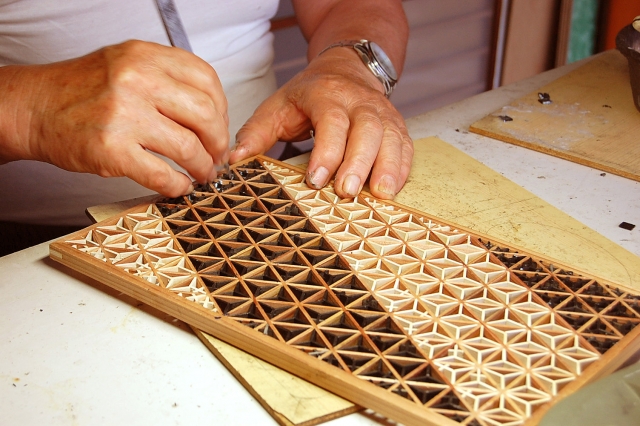
Processed components are assembled according to design drawings. While there are various assembly methods in Kumiko, the fundamentals are techniques such as “mitsukumite” (three-piece joint), “yotsukumite” (four-piece joint), and “mutsukumite” (six-piece joint). These are methods of intersecting 3, 4, or 6 components at one point, and by applying these basic techniques, complex patterns can be created.
Assembly proceeds from the outside toward the center, or from the center toward the outside. Since it is difficult to remove components once assembled, mistakes in procedure require starting over from the beginning. Even skilled craftsmen may require days to weeks to assemble complex patterns.
Representative Kumiko Patterns
Kumiko has hundreds of traditional patterns. Each pattern has a name and meaning, used according to purpose and location.
Asanoha (Hemp Leaf)
One of the most famous Kumiko patterns. A geometric pattern based on regular hexagons, named for its resemblance to hemp leaves. Because hemp grows quickly and is strong, it symbolizes healthy growth and protection from evil. It was used in children’s room shoji screens to wish for children’s health.
Gomagara (Sesame Shell)
A pattern of continuous hexagons resembling sesame shells. Characterized by honeycomb-like regular arrangement, it symbolizes prosperity and abundance. Simple yet beautiful, it is used in various joinery.
Mitsukumite (Three-piece Joint)
A basic pattern combining three components at 120-degree angles. While simple, it gives a powerful impression and is an important technique forming the foundation of Kumiko. Mastering this technique is the first step to becoming a Kumiko craftsman.
Sakura (Cherry Blossom)
An elegant pattern modeled after cherry blossom petals. It has curved elements and is one of the very difficult patterns to create. Used in decorations such as transom panels as a symbol of spring’s arrival and beauty.
Kikko (Tortoiseshell)
A pattern based on regular hexagons, resembling a tortoise shell. Because tortoises symbolize longevity, it is favored as an auspicious pattern. The regular arrangement is beautiful, giving a balanced impression.
Uses of Kumiko
Traditional Uses
Kumiko has traditionally been used in various parts of Japanese architecture:
- Shoji: Kumiko is used in the frames of shoji screens for room partitions and windows in Japanese rooms
- Ranma: Decorative openings between the ceiling and lintel
- Lattice Doors: Decorative joinery used in entrances and windows
- Tsuitate: Movable partitions for dividing interior spaces
- Andon: As decoration for lighting fixtures
Modern Uses
In modern times, Kumiko is being utilized in new fields in addition to traditional uses:
- Interior Panels: As wall decoration or partitions
- Lighting Fixtures: Shades for pendant lights and stand lights
- Furniture: Decoration for tables, shelves, storage boxes
- Art Pieces: Framed Kumiko as artistic works
- Small Items: Coasters, tissue cases, accessories
Kumiko Production Areas
There are Kumiko production areas throughout Japan, but the following regions are particularly famous:
Toyama Prefecture (Toyama Kumiko): Toyama Prefecture is known as a major production area for Kumiko. Particularly in the Inami area, elaborate transom panels combining carving and Kumiko are made.
Niigata Prefecture (Niigata Kumiko): In Niigata Prefecture, Kumiko developed within the architectural culture unique to snowy regions. Particularly in Kamo City and Sanjo City, high-quality Kumiko joinery is produced.
Fukuoka Prefecture (Hakata Kumiko): Hakata Kumiko is characterized by delicate and complex patterns. While preserving traditional techniques, they also challenge modern designs.
Modern Value of Kumiko
Kumiko is finding new value in modern society. From a sustainability perspective, Kumiko, which uses no adhesives or nails, is attracting attention as environmentally friendly craftsmanship. Additionally, precision processing by hand has warmth and value that cannot be obtained through mass production.
Overseas as well, the geometric beauty and precision techniques of Kumiko are highly valued. There are increasing examples of architects and designers incorporating Kumiko designs into contemporary architecture and interiors. Japanese traditional techniques are opening new possibilities in the global design world.
How to Experience and Appreciate Kumiko
For those interested in Kumiko, we recommend viewing actual pieces at traditional craft museums and museums throughout the country. Additionally, experience classes for Kumiko are held in production areas such as Toyama and Niigata Prefectures. Beginner courses offer experiences such as making coasters with simple patterns.
Visiting Kumiko craftsmen’s workshops is also possible. Observing craftsmen’s handwork up close and touching their skill and passion provides an excellent opportunity to understand the appeal of Kumiko more deeply.
Conclusion
Kumiko is traditional Japanese woodcraft art that creates works by precisely assembling wood without using nails. With over 1,400 years of history, advanced techniques requiring millimeter-level precision can only be realized by craftsmen who have undergone years of training.
Hundreds of beautiful patterns such as asanoha, gomagara, and kikko each have meaning, expressing Japanese aesthetic sensibility and spirituality. From traditional uses such as shoji screens and transom panels to contemporary interiors and art pieces, Kumiko continues to be loved across time.
Environmentally friendly and possessing the warmth of handwork, Kumiko teaches the value of creating things slowly and carefully in a modern society that demands efficiency and speed. Please experience the world of Kumiko, the crystallization of Japanese craftsmanship.




![[:ja]日本の文化を支える外国人たち。日本文化を世界に…![:en]Expats supporting Japanese culture. Help spread Japanese culture across the world![:]](https://japanese-tradition.com/wp-content/uploads/wordpress-popular-posts/3013-featured-15x15.jpg)
![[:ja]美しい!日本の伝統工芸「てまり」[:en]Temari is Beautiful! Japanese traditional art[:]](https://japanese-tradition.com/wp-content/uploads/wordpress-popular-posts/18-featured-15x15.jpg)
![[:ja]九州には魅力的な県がいっぱい!8つの県が集まる九州地方を知ろう![:en]Kyushu with Its Fascinating Eight Prefectures![:]](https://japanese-tradition.com/wp-content/uploads/wordpress-popular-posts/2798-featured-15x15.jpg)
![[:ja]歴史的な建物から近代的なものまで!日本の有名な建造物10選[:en]The Top Ten Landmarks in Japan - From the Historical to the Modern![:]](https://japanese-tradition.com/wp-content/uploads/wordpress-popular-posts/2033-featured-15x15.jpg)
![[:ja]芸者遊びは粋な大人の遊び!ルールを守って楽しく遊ぼう[:en]Geisha games | Innocent fun for adults[:]](https://japanese-tradition.com/wp-content/uploads/wordpress-popular-posts/1359-featured-15x15.jpg)
![[:ja]日本のクラシックパンツ「ふんどし」[:en]FUNDOSHI is the underwear of the Japanese style[:]](https://japanese-tradition.com/wp-content/uploads/wordpress-popular-posts/144-featured-15x15.jpg)
![[:ja]日本の伝統的な遊び道具「コマ」ってどんな遊び方をするの?[:en]Koma is a traditional Japanese toy. How do we play? [:]](https://japanese-tradition.com/wp-content/uploads/wordpress-popular-posts/238-featured-15x15.jpg)
![[:ja]竹でできた馬ってな~んだ?~竹馬~[:en]Bamboo stilts (Takeuma)[:]](https://japanese-tradition.com/wp-content/uploads/wordpress-popular-posts/306-featured-15x15.jpg)
![[:ja]“間”の美学とは?日本建築に宿る静寂と余白の精神[:en]The Beauty of Ma: Stillness and Space in Japanese Architecture[:]](https://japanese-tradition.com/wp-content/uploads/wordpress-popular-posts/3354-featured-15x15.jpg)
![[:ja]世界には親日家の有名人が沢山!![:en]International celebrities who love Japan![:]](https://japanese-tradition.com/wp-content/uploads/wordpress-popular-posts/2978-featured-15x15.jpg)
