
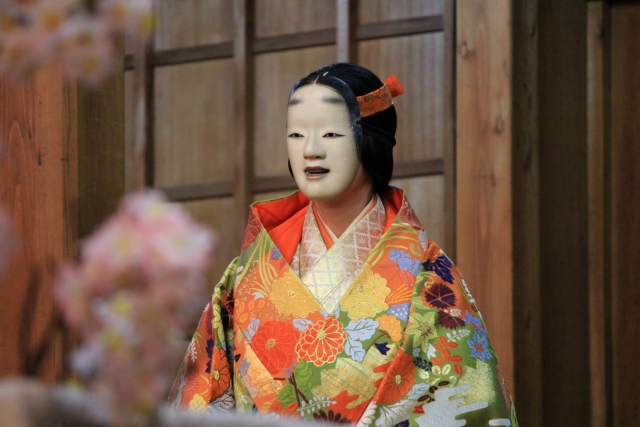
What is Noh Theatre?
Noh theatre is a collective term for two theatrical forms: “Noh” and “Kyogen.” Noh is a musical drama where masked protagonists develop stories centered on dance and chanting (utai), while Kyogen is a comedy centered on dialogue performed without masks. These two forms combine to create a single performance program, each offering contrasting attractions.
The origins of Noh theatre date back to the 14th century. It was perfected by the father-son duo of Kan’ami and Zeami, and flourished during the Muromachi period under the patronage of Shogun Ashikaga Yoshimitsu. Theoretical texts left by Zeami, such as “Fushikaden” (The Transmission of the Flower of Acting Style), remain spiritual pillars of Noh theatre to this day.
The Noh Stage and Structure
Characteristics of the Noh Stage
The Noh stage has a distinctive structure: a square main stage, a passageway called the hashigakari, and a painting of an old pine tree as the backdrop. This austere stage itself symbolizes the worldview of Noh theatre. With almost no props, every scene is expressed solely through the performers’ movements and words.
The stage floor is made entirely of cypress wood and produces instrument-like resonance when foot stomps are performed. Additionally, pillars stand at the four corners of the stage, called “metsuke-bashira,” “shite-bashira,” “waki-bashira,” and “fue-bashira,” serving as positioning markers for performers.
Structure of Noh Plays
Noh plays are classified into five categories based on their content:
- First Category (Waki-noh): Celebratory works featuring deities
- Second Category (Shura-mono): Works featuring the ghosts of warriors
- Third Category (Kazura-mono): Graceful works with female protagonists
- Fourth Category (Zatsu-noh): Works dealing with various subjects
- Fifth Category (Kiri-noh): Dynamic works featuring demons and tengu
In a full-day performance, these are staged in order, with Kyogen interludes creating a program with varied pacing.
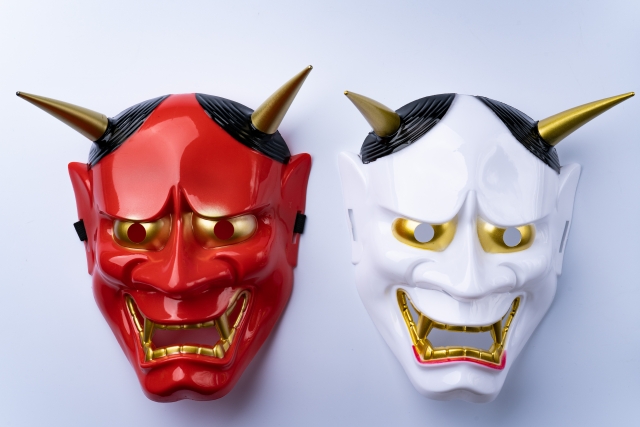
Noh Masks – Expressiveness of Seemingly Emotionless Faces
Noh masks are a crucial element symbolizing Noh theatre. While appearing expressionless at first glance, Noh masks express joy, anger, sorrow, and pleasure through angles and lighting. This technique called “terukumori” (illumination and shadow) is unique to Noh.
There are many types of Noh masks, each expressing specific roles or emotions:
- Ko-omote: A beautiful mask representing young women
- Hannya: A demon mask of a woman crazed with jealousy
- Okina: A sacred old man’s mask
- Chujo: A mask representing a noble youth
- Jo: A mask representing old men
Noh masks are carved from wood and painted using traditional techniques. Ancient masks created hundreds of years ago are still carefully used today, their profound expressions radiating timeless beauty.
The Aesthetic of “Yugen”
Essential to discussing the essence of Noh theatre is the concept of “Yugen.” Yugen refers to profound beauty that cannot be fully explained in words, a realm of mystical and elegant beauty. Zeami established this Yugen as the highest aesthetic ideal of Noh theatre.
Movements stripped to the bare minimum, chanting and instrumental music resonating in silence, and stories that progress slowly over time—all of these combine to manifest the world of Yugen. Audiences are asked to perceive not only what is visible but also the invisible world behind it.
Movements and Forms in Noh
All movements in Noh are defined as “kata” (forms). The way of walking, sitting, and using fans—everything has meaning and is acquired through years of training.
Particularly distinctive is the walking style called “suriashi” (sliding steps). By sliding feet without lifting them from the floor, the center of gravity stabilizes, creating a mystical sense of floating. Additionally, fans are used to represent various objects: the moon, sake cups, swords, letters—a single fan holds countless meanings depending on the scene.
Kyogen – The Art of Laughter Paired with Noh
While Noh expresses the world of Yugen, Kyogen is a comedy depicting everyday life of common people. However, Kyogen is also an art requiring advanced technique and, like Noh, has a tradition spanning over 600 years.
Kyogen plays depict comical aspects of human nature: exchanges between masters and servants, marital quarrels, deceptions. The dialogue is close to colloquial speech, and gestures are large, making the content more accessible in contrast to Noh. By alternating between Noh and Kyogen, audiences can enjoy a balance of tension and relaxation.
The Significance of Noh Theatre in Modern Times
Even in modern times, Noh theatre continues as a living art form. There are Noh theatres throughout the country where regular performances are held. It has also been incorporated into school education, increasing opportunities for younger generations to experience Noh theatre.
In recent years, overseas performances have become active, captivating many people across language barriers. The aesthetics of Noh—minimalism, meditative quietness, symbolic expression—resonate with contemporary art, and it is being reevaluated from new perspectives.
How to Experience Noh Theatre
For those interested in Noh theatre, we recommend first attending an actual performance. The National Noh Theatre in Tokyo and Noh theatres in various regions offer performances with explanations for beginners. Additionally, Noh experience classes are held in various locations where you can actually try chanting and shimai (portions of dance).
While it may seem difficult at first, it is entirely possible to feel the atmosphere and beauty even without prior knowledge. In the slowly flowing time, forget daily life and surrender yourself to the world of Yugen.
Conclusion
Noh theatre is Japan’s representative traditional performing art that has been passed down for over 600 years. The world of Yugen woven by masks, dance, chanting, and music continues to captivate people across time.
Expression stripped to the bare minimum, symbolic movements, and profound spirituality—Noh theatre cultivates the power to perceive not only what is visible but what is invisible. In modern society where efficiency and speed are demanded, it teaches the aesthetics of “ma” (intervals) and “yohaku” (margins) that are being lost.
For foreign tourists, Noh theatre is a precious opportunity to touch the essence of Japanese spiritual culture. Even without fully understanding the language, its serene beauty and mysticism will surely resonate with your heart. Please experience the power of art that has been passed down across 600 years.


![[:ja]九州には魅力的な県がいっぱい!8つの県が集まる九州地方を知ろう![:en]Kyushu with Its Fascinating Eight Prefectures![:]](https://japanese-tradition.com/wp-content/uploads/wordpress-popular-posts/2798-featured-15x15.jpg)
![[:ja]日本の文化を支える外国人たち。日本文化を世界に…![:en]Expats supporting Japanese culture. Help spread Japanese culture across the world![:]](https://japanese-tradition.com/wp-content/uploads/wordpress-popular-posts/3013-featured-15x15.jpg)
![[:ja]歴史的な建物から近代的なものまで!日本の有名な建造物10選[:en]The Top Ten Landmarks in Japan - From the Historical to the Modern![:]](https://japanese-tradition.com/wp-content/uploads/wordpress-popular-posts/2033-featured-15x15.jpg)
![[:ja]“間”の美学とは?日本建築に宿る静寂と余白の精神[:en]The Beauty of Ma: Stillness and Space in Japanese Architecture[:]](https://japanese-tradition.com/wp-content/uploads/wordpress-popular-posts/3354-featured-15x15.jpg)
![[:ja]日本のクラシックパンツ「ふんどし」[:en]FUNDOSHI is the underwear of the Japanese style[:]](https://japanese-tradition.com/wp-content/uploads/wordpress-popular-posts/144-featured-15x15.jpg)
![[:ja]芸者遊びは粋な大人の遊び!ルールを守って楽しく遊ぼう[:en]Geisha games | Innocent fun for adults[:]](https://japanese-tradition.com/wp-content/uploads/wordpress-popular-posts/1359-featured-15x15.jpg)
![[:ja]ビジュアル系ファッション - ロックと美の融合[:en]Visual Kei Fashion - The Fusion of Rock and Beauty[:]](https://japanese-tradition.com/wp-content/uploads/wordpress-popular-posts/3417-featured-15x15.jpg)
![[:ja]日本の伝統的な遊び道具「コマ」ってどんな遊び方をするの?[:en]Koma is a traditional Japanese toy. How do we play? [:]](https://japanese-tradition.com/wp-content/uploads/wordpress-popular-posts/238-featured-15x15.jpg)
![[:ja]竹でできた馬ってな~んだ?~竹馬~[:en]Bamboo stilts (Takeuma)[:]](https://japanese-tradition.com/wp-content/uploads/wordpress-popular-posts/306-featured-15x15.jpg)
![[:ja]日本のレストランで出てくるお冷が全部タダなのはなぜ!?[:en]Ohiya: free water in restaurants?[:]](https://japanese-tradition.com/wp-content/uploads/wordpress-popular-posts/523-featured-15x15.jpg)
